Top 20 Important Medical Signs

Top 20 Important Medical Signs Every Healthcare Student Should Know

Top 20 Important Medical Signs

Medical signs are essential tools used by healthcare professionals to identify diseases during physical examination. Even before laboratory tests or imaging studies, careful observation of clinical signs can provide important clues about underlying health conditions. For medical and nursing students, understanding these signs is crucial for accurate diagnosis and patient care.

1. Murphy’s Sign

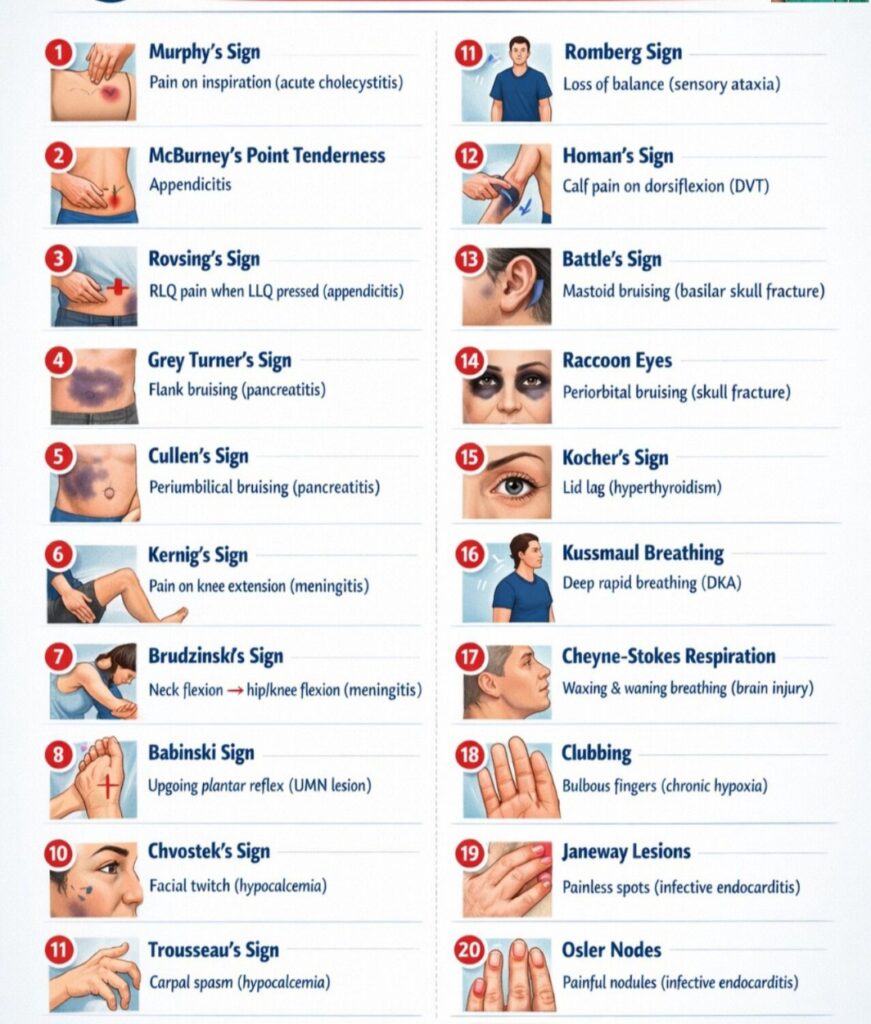
Murphy’s sign is tested by pressing under the right rib cage while the patient inhales. Sudden pain causing the patient to stop breathing indicates a positive sign. It suggests inflammation of the gallbladder, most commonly acute cholecystitis, usually caused by gallstones blocking the cystic duct.

2. McBurney’s Point Tenderness

Pain at McBurney’s point, located in the right lower abdomen between the navel and hip bone, suggests acute appendicitis. Tenderness occurs due to inflammation of the appendix. It is an important clinical sign used along with fever, nausea, and elevated white blood cell count.

3. Rovsing’s Sign

Rovsing’s sign is positive when pressing the left lower abdomen causes pain in the right lower abdomen. This happens due to peritoneal irritation and strongly suggests appendicitis. The maneuver increases pressure inside the abdomen, triggering pain at the inflamed appendix site.

4. Grey Turner’s Sign

Grey Turner’s sign refers to bluish discoloration or bruising on the flanks (sides of the abdomen). It indicates internal bleeding, often seen in severe acute pancreatitis or retroperitoneal hemorrhage. It usually appears late and suggests serious disease with possible complications.

5. Cullen’s Sign

Cullen’s sign is bruising around the umbilicus (navel). It occurs due to internal bleeding tracking to the skin surface. Common causes include acute pancreatitis, ruptured ectopic pregnancy, or abdominal trauma. It is a warning sign of significant intra-abdominal bleeding.

6. Kernig’s Sign

Kernig’s sign is checked by flexing the patient’s hip and attempting to straighten the knee. Pain or resistance indicates meningeal irritation. It is commonly associated with meningitis, where inflammation of the brain coverings causes muscle stiffness and discomfort.

7. Brudzinski’s Sign

Brudzinski’s sign occurs when bending the patient’s neck forward causes automatic bending of the hips and knees. This reflex movement indicates irritation of the meninges and is strongly suggestive of meningitis or subarachnoid inflammation.

8. Babinski Sign

The Babinski sign is tested by stroking the sole of the foot. Upward movement of the big toe with fanning of other toes indicates an upper motor neuron lesion in adults. It is normal in infants but abnormal in older children and adults.

9. Chvostek’s Sign

Chvostek’s sign is facial muscle twitching after tapping the facial nerve near the cheek. It indicates increased nerve excitability caused by hypocalcemia (low calcium levels). It may be seen in conditions like hypoparathyroidism or vitamin D deficiency.

10. Trousseau’s Sign

Trousseau’s sign is carpal spasm produced by inflating a blood pressure cuff on the arm. The hand contracts into a characteristic position due to nerve irritability from low calcium levels. It is considered more specific for hypocalcemia than Chvostek’s sign.

11. Romberg Sign

.Romberg sign tests balance. The patient stands with feet together and eyes closed. Loss of balance indicates sensory ataxia, often due to problems in proprioception pathways, peripheral neuropathy, or vitamin B12 deficiency affecting nervous system coordination.

12. Homan’s Sign

Homan’s sign is calf pain when the foot is dorsiflexed upward. It may suggest deep vein thrombosis (DVT) due to irritation of inflamed veins. However, it is not very reliable and modern diagnosis relies more on ultrasound imaging.

13. Battle’s Sign

Battle’s sign is bruising behind the ear over the mastoid area. It indicates a basilar skull fracture, usually caused by head trauma. The bruising appears hours after injury and suggests serious cranial damage requiring urgent medical evaluation.

14. Raccoon Eyes

Raccoon eyes describe dark bruising around both eyes caused by blood collecting in periorbital tissues. It is commonly associated with basilar skull fractures. The appearance resembles a raccoon mask and indicates significant head injury.

15. Kocher’s Sign

Kocher’s sign refers to eyelid lag when the patient looks downward. The upper eyelid moves slower than the eyeball, exposing more sclera. It is commonly seen in hyperthyroidism, especially Graves’ disease, due to increased sympathetic nervous system activity.

16. Kussmaul Breathing

Kussmaul breathing is deep, rapid, labored breathing seen in diabetic ketoacidosis (DKA). The body attempts to remove excess acid by blowing off carbon dioxide. It is a compensatory mechanism for metabolic acidosis and indicates a medical emergency.

17. Cheyne–Stokes Respiration

Cheyne–Stokes breathing shows cycles of gradually increasing and decreasing breathing followed by pauses (apnea). It occurs in brain injury, stroke, heart failure, or severe illness. It reflects impaired respiratory control in the brain.

18. Clubbing

Clubbing is enlargement and rounding of fingertips with loss of normal nail angle. It develops due to long-term chronic hypoxia. Common causes include lung disease, congenital heart disease, and chronic infections affecting oxygen delivery.

19. Janeway Lesions

Janeway lesions are painless, red spots on palms and soles caused by septic emboli. They are associated with infective endocarditis. These lesions result from bacterial infection spreading through the bloodstream and lodging in small vessels.

20. Osler Nodes

.Osler nodes are painful, tender nodules usually found on fingers or toes. They occur in infective endocarditis due to immune complex deposition causing inflammation in blood vessels. Unlike Janeway lesions, they are painful and indicate systemic infection.

Leave a Comment

Your email address will not be published. Required fields are marked *

Scroll to Top