30 Important Blood Tests Everyone Should Know and What They Mean
What is Blood Test
A blood test is a medical test in which a small sample of blood is taken from your body (usually from a vein in your arm) and examined in a laboratory. 🧪 This test helps doctors understand how well your body and organs are working and can help detect many health conditions.
Why Blood Test are done?
✅ Check your overall health
✅ Diagnose diseases or infections
✅ Monitor medical conditions
✅ Check how well organs like the liver, kidneys, and heart are working
✅ Measure levels of substances such as sugar, cholesterol, hormones, and vitamins
What Blood Tests Can Detect
Blood tests can help identify conditions such as:
Diabetes
Anemia
Thyroid disease
HIV/AIDS
Hepatitis
Infections and inflammation in the body
1. Complete Blood Count (CBC)
What it measures:
Hemoglobin (Hb): Oxygen-carrying protein 👉 Low = anemia 👉 High = dehydration or lung disease
Red Blood Cells (RBC): Carry oxygen 👉 Low = anemia, blood loss
White Blood Cells (WBC): Fight infection 👉 High = infection or inflammation
Platelets: Help blood clot 👉 Low = bleeding risk
2. Blood Sugar Tests (Glucose Tests)
Purpose: Detect diabetes and monitor sugar levels.
Types:
Fasting Blood Sugar (FBS): After 8–10 hours fasting
Postprandial Blood Sugar (PPBS): After meals
HbA1c: Average sugar level of last 2–3 months
Meaning:
High levels → Diabetes or prediabetes
Low levels → Hypoglycemia
3. Lipid Profile (Cholesterol Test)
Purpose: Checks heart disease risk.
Includes:
Total Cholesterol
LDL (Bad cholesterol) → High increases heart risk
HDL (Good cholesterol) → Higher is better
Triglycerides → High levels increase heart disease risk
4. Liver Function Test (LFT)
Purpose: Checks liver health.
Important values:
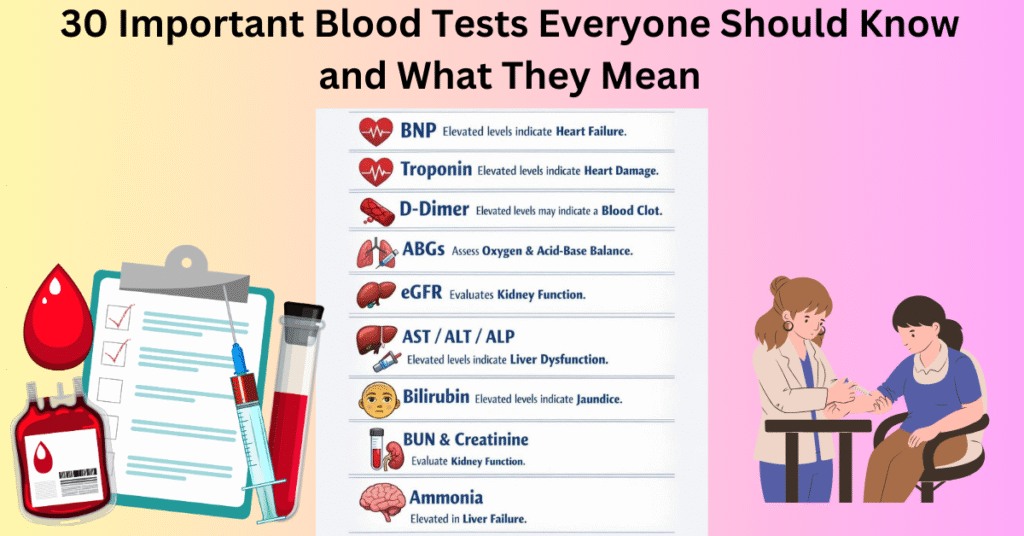
ALT & AST: Liver enzymes 👉 High = liver damage or infection
Bilirubin: 👉 High = jaundice or liver problems
Albumin: Protein made by liver
5. Kidney Function Test (KFT / RFT)
Purpose: Evaluates kidney function.
Measures:
Creatinine: Waste filtered by kidneys 👉 High = kidney problem
Urea (BUN): Waste product in blood
Electrolytes (Sodium, Potassium)
6. Thyroid Function Test (TFT)
Purpose: Checks thyroid gland activity.
Includes:
TSH
T3
T4
Meaning:
High TSH → Hypothyroidism (slow thyroid)
Low TSH → Hyperthyroidism (overactive thyroid)
7. Vitamin Tests
Common ones:
Vitamin D: Bone and immunity health 👉 Low = weakness, bone pain
Vitamin B12: Nerve and blood health 👉 Low = fatigue, numbness
8. Iron Studies
Purpose: Diagnose anemia.
Tests:
Serum Iron
Ferritin (iron storage)
TIBC
Low ferritin → Iron deficiency anemia.
9. C-Reactive Protein (CRP)
Purpose: Detects inflammation or infection.
High CRP → Infection, inflammation, or heart risk.
10. Coagulation Profile (PT/INR)
Purpose: Checks blood clotting ability.
Used before surgery or for patients on blood thinners.
11. ESR (Erythrocyte Sedimentation Rate)
Purpose: Detects inflammation.
High ESR → Infection, autoimmune disease, or chronic illness.
12. Blood Group & Rh Typing
Purpose: Determines blood type (A, B, AB, O and Rh factor).
Important for blood transfusion and pregnancy.
13. HbA1c (Glycated Hemoglobin)
Purpose: Long-term diabetes monitoring.
Meaning:
Shows average blood sugar for last 2–3 months
High value → Diabetes not well controlled
14. Blood Culture Test
Purpose: Detects bacteria or fungus in blood.
Meaning:
Positive result → Serious infection (sepsis)
Helps doctors choose correct antibiotics
15. Cardiac Markers (Heart Tests)
Used when heart attack is suspected.
Important markers:
Troponin: Most important heart damage marker
CK-MB: Indicates heart muscle injury
High levels → Possible heart attack.
16. D-Dimer Test
Purpose: Detects blood clots.
Meaning:
High value → Possible clot in lungs or legs (DVT/PE)
Often used in emergency cases.
17. Calcium Test
Purpose: Checks bone, nerve, and muscle health.
Meaning:
Low calcium → Vitamin D deficiency or kidney disease
High calcium → Hormonal or bone problems
18. Electrolyte Panel
Measures:
Sodium
Potassium
Chloride
Bicarbonate
Meaning:
Imbalance may cause weakness, confusion, heart rhythm problems.
19. Procalcitonin (PCT)
Purpose: Detects severe bacterial infection.
High level → Serious infection or sepsis.
20. Amylase and Lipase
Purpose: Check pancreas health.
High levels → Pancreatitis (pancreas inflammation).

Pingback: Top 20 Important Medical Signs